
Seasats Deploys Fleet of Lightfish USVs for Maritime Border Security in the Gulf of America
PR Newswire
SAN DIEGO, Oct. 2, 2026
Unmanned surface vessel fleet will provide persistent surveillance across the Gulf of America, expanding on earlier operations along the southern border
SAN DIEGO, Oct. 2, 2026 /PRNewswire/ — Seasats today announced that a fleet of Lightfish unmanned surface vessels (USVs) has been deployed in support of U.S. maritime border security operations, expanding an existing autonomous maritime surveillance program under the Office of the Assistant Secretary of War for Homeland Defense and Americas Security Affairs.
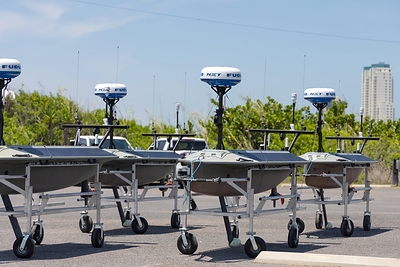
Launched from the Texas coast into the Gulf of America, the fleet will conduct persistent autonomous surveillance to detect illegal maritime activity, including drug trafficking and other unauthorized vessel ingress. The deployment builds on Seasats’ previous support of Operation River Wall along the southern border.
Since January 2026, Lightfish vessels have operated on the Rio Grande in support of federal border security efforts, providing surveillance and early warning alongside crewed patrol assets in an environment that had not previously seen sustained USV operations. The Gulf deployment carries that mission into open water.
Maritime domain awareness offshore has traditionally relied heavily on manned aircraft and boat patrols, which are limited by crew endurance, operating cost, and the area any single asset can cover at one time. Federal oversight reviews have repeatedly identified aging cutters and aircraft availability as constraints on interdiction capacity. Operating autonomously and without a crew aboard, the Lightfish fleet is designed to function as an unblinking eye on the water, creating a continuous surveillance fence that closes significant spatial and temporal gaps while complementing assets already in the region.
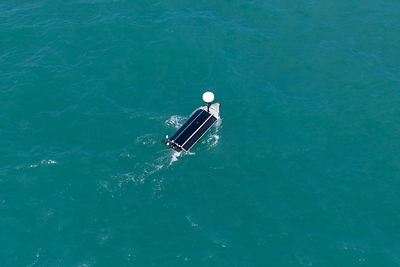
Each Lightfish is roughly 11 feet long and 340 pounds. The vessels are solar powered, capable of multi-month endurance on station, and small enough to be launched and recovered by two people from a boat ramp or the back of a pickup truck. A modular payload bay has carried electro-optical and infrared cameras, signals payloads, and sonar across prior missions, allowing a single hull design to be configured for the sensing task at hand.
“The Gulf is too vast to monitor with crewed hulls alone. Traditional patrols burn fuel, have high hourly costs, and can only stay out as long as the people on board. A Lightfish is solar powered and has no one aboard, so it can hold station for months in conditions where you wouldn’t want to put a crew. With a fleet of them working together, we get continuous coverage of an area that has only previously been seen in snapshots,” said Mike Flanigan, CEO of Seasats.
The deployment marks a significant expansion of operational autonomous maritime surveillance at the U.S. southern border and reflects the growing role of USVs in homeland security missions.
“The rapid pace of commercial innovation presents a tremendous opportunity for our Homeland Defense mission. By partnering with industry to rapidly prototype and field mature, scalable technologies, we can close critical capability gaps and deliver relevant solutions into the hands of our warfighters. Seasats is one of many industry partners that help secure our nation’s complex maritime domain. We have progressively prototyped and piloted solutions using their Lightfish USV in the challenging riverine environment of the Rio Grande and the vast expanse of the Gulf of America. This is all part of our efforts to gain 100% operational control of our borders,” said ASW Mark R Ditlevson, Assistant Secretary of War, Homeland Defense and Americas Security Affairs.
About Seasats
Seasats closes maritime blind spots. Border protection, port security, tripwire operations, countering illegal trafficking and fishing, oceanographic research, hydrographic survey, and other missions depend on continuous awareness across key stretches of water. Seasats makes that possible through networked systems of unmanned surface vessels that operate persistently, maintain continuous data streams, and act when required.
Seasats has over $100 million in U.S. government contracts and vessels operating with the U.S. Navy, NOAA, and leading research institutions worldwide. The company is headquartered in San Diego and backed by groups including Shield Capital, L3Harris Technologies, and Konvoy Ventures.

 View original content to download multimedia:https://www.prnewswire.com/news-releases/seasats-deploys-fleet-of-lightfish-usvs-for-maritime-border-security-in-the-gulf-of-america-302896922.html
SOURCE Seasats


